
What landlords should do when a tenant sues—and the insurance company has not responded.
You have been served with a tenant's lawsuit alleging mold, pests, plumbing problems, or other unsafe living conditions. You sent the papers to your insurance broker, but no defense attorney has contacted you. Meanwhile, the deadline to respond is approaching.
Will your landlord insurance pay for a lawyer? Will it cover a settlement or judgment? Should you hire an attorney before the insurance company makes its decision?
Landlord liability insurance may cover your defense and covered damages, but the answer depends on the policy and the allegations. The insurer's duty to defend is broader than its duty to pay damages. Waiting for a coverage decision does not automatically extend your lawsuit response deadline.
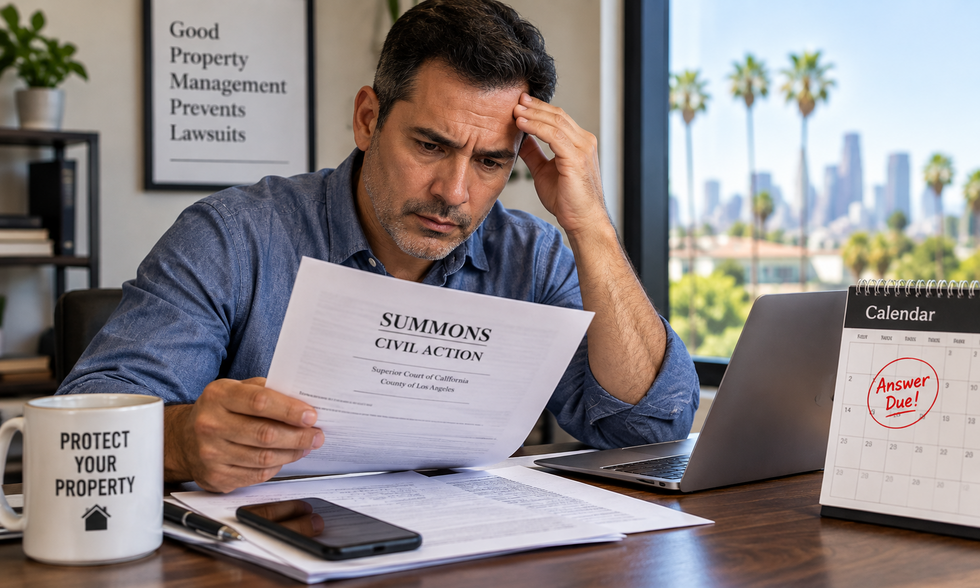
My Insurance Has Not Responded, and My Answer Is Due. What Should I Do?
Seek legal help to protect the response deadline while the insurance review continues.
For an ordinary California civil damages lawsuit, a defendant personally served with a summons and complaint generally has 30 calendar days to respond. Different service methods and valid extensions can affect the calculation, so an attorney should confirm the deadline from the actual service information. Failure to respond can expose you to default and a judgment without your side being heard.
A claim number, acknowledgment email, or statement that an adjuster is “reviewing coverage” is not a response filed in court. Ask for confirmation of whether the insurer is accepting your defense, who the appointed attorney is, and who is handling the deadline.
When contacting a landlord defense attorney, explain immediately that you have already been served and identify the anticipated response date. Ask counsel to evaluate the appropriate court response or a valid extension while addressing insurance coverage.
Does Landlord Insurance Cover a Tenant's Habitability Lawsuit?
Possibly—but property coverage and liability coverage are different.
Property insurance generally addresses covered damage to the insured building or other insured property. Liability coverage addresses covered claims against the insured, including certain claims involving injury to another person or damage to someone else's property. A policy that covers building repairs does not necessarily cover a tenant's lawsuit.
The review should therefore include the landlord policy's liability provisions, any commercial general liability policy, and potentially relevant umbrella or excess policies—not just the declarations page.
Paying for Your Defense
The duty to defend concerns the insurer's obligation to provide a legal defense. Under California law, that duty can arise when the complaint or other facts known to the insurer create a potential for coverage, even when the insurer ultimately owes no payment toward a judgment.
When at least one claim remains potentially covered, the insurer ordinarily must defend the entire mixed action, subject to applicable reimbursement principles. However, policy exclusions may eliminate that potential altogether.
Paying a Settlement or Judgment
The duty to indemnify concerns payment for liability actually covered by the policy. Providing a lawyer does not mean the insurer has agreed to pay every settlement demand or damage award. Coverage remains subject to the facts, policy terms, exclusions, and limits.
Ask counsel to evaluate the requested damages separately, including claimed personal injuries, damage to belongings, rent reimbursement, statutory remedies, and attorney's fees. Do not assume every category receives the same coverage treatment.
Punitive damages imposed for the insured's own intentional, morally blameworthy misconduct generally cannot be shifted to an insurer under California law.
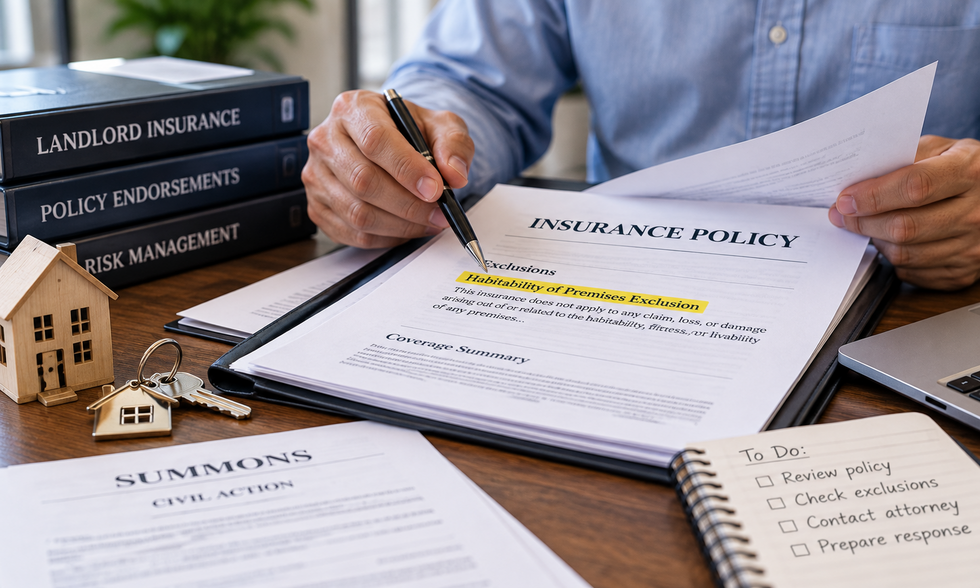
Can a Habitability Exclusion Eliminate Insurance Coverage?
Yes. The exact exclusion language matters.
In 24th & Hoffman Investors, LLC v. Northfield Insurance Co. (2022), the California Court of Appeal enforced a habitability exclusion that extended to other claims within a lawsuit that also alleged habitability violations. Under that policy, adding claims that were arguably unrelated to habitability did not create a duty to defend.
That decision does not establish that every tenant lawsuit is uninsured. It demonstrates why a lawyer must read the actual endorsement rather than assume that a negligence claim guarantees coverage—or that the word “habitability” automatically defeats it.
The policy's definition of an occurrence also deserves attention. Some liability policies include continuous or repeated exposure to harmful conditions. A condition developing over time is therefore not automatically outside coverage merely because it was gradual; the allegations, policy wording, and exclusions still control.
Ask your attorney to examine any habitability or mold-related exclusion and any endorsement that modifies or restores coverage.
How Should I Ask My Insurance Company to Defend Me?
Requesting that the insurer take over your defense is commonly called tendering the defense. Where a duty to defend exists, tender is important to triggering that obligation.Send the lawsuit papers promptly through the insurer's designated claims channel, copy your broker, and obtain confirmation of receipt. Make the request explicit: you are requesting a defense of the tenant's lawsuit, not simply reporting a maintenance problem.
Prepare these materials for counsel:
- The lawsuit and service information: The summons, complaint, exhibits, and details showing when and how each defendant was served.
- The complete insurance documents: Policies, declarations, schedules of forms, and every endorsement for potentially relevant policy periods.
- The factual and claim records: Tenant communications, repair requests, inspection reports, photographs, maintenance invoices, and all correspondence with the insurer or broker.
Preserve existing records and discuss ongoing repair obligations with counsel. A pending lawsuit is not a reason to disregard conditions that require attention.
Do not postpone contacting an attorney because you have not yet located every document. Start with the lawsuit papers and deadline information.
Can I Hire My Own Lawyer While Insurance Investigates?
Yes. Discuss immediate representation when no insurer-appointed lawyer is protecting your response deadline. However, hiring an attorney does not automatically obligate the insurer to reimburse every legal bill.
Recovery of privately incurred defense expenses can depend on the policy, when the defense was tendered, whether the insurer breached an obligation, and the circumstances requiring the expenditure. California decisions enforce certain restrictions on voluntary or pre-tender expenses, while recognizing that circumstances requiring an immediate response can matter.
Ask counsel to coordinate the defense request, seek appropriate insurer authorization, and preserve invoices and communications. The goal is to protect your position in court without unnecessarily compromising a claim for insurance benefits.
Frequently Asked Questions About Habitability Lawsuit Insurance Coverage
Does Reporting the Lawsuit to My Broker Protect Me From Default?
No. Reporting an insurance claim is not the same as responding to the complaint. Confirm that an attorney is handling the court deadline and that the required response or a valid extension is in place.
What Does a Reservation of Rights Letter Mean?
An insurer may provide a defense while reserving the right to dispute coverage or seek reimbursement in appropriate circumstances. Have an attorney review what the letter actually reserves; do not treat it as an unconditional promise to pay.
A reservation of rights does not automatically entitle you to choose independent counsel at the insurer's expense. That question requires a conflict-of-interest analysis under California Civil Code section 2860.
What Should I Do if the Insurer Denies the Entire Lawsuit?
Have counsel compare the denial letter with the complete policy, complaint, and relevant facts. Some exclusions can validly eliminate the entire defense obligation, but a denial should be evaluated against the actual policy—not a general statement that habitability cases are never covered.
Speak With a Los Angeles Landlord Defense Attorney
The Law Office of Steve Lopez represents landlords facing tenant disputes and habitability claims. Contact our office to discuss the lawsuit, potential insurance coverage, insurer correspondence, and a defense strategy.

If your response deadline is approaching, make that the first thing you tell us.
Call (562) 904-1193 to discuss your matter with the Law Office of Steve Lopez, located at 8562 Florence Avenue, Suite A, Downey, California 90240.
This blog post is for informational purposes only and does not constitute legal advice or establish an attorney-client relationship. Insurance coverage and litigation deadlines depend on the specific policy, facts, and procedural circumstances.
Comments
There are no comments for this post. Be the first and Add your Comment below.
Leave a Comment