

Immigration consultants facing high-pressure lawsuits under California's Immigration Consultant Act (ICA) finally have a major legal victory to celebrate.
In a pivotal appellate ruling filed October 24, 2025, the California Court of Appeal in reversed a shocking $83,197.50 attorney fee award that had been granted to a plaintiff known for filing boilerplate lawsuits against consultants. The court ruled that the award was excessive, unsupported by the record, and must be reconsidered by the trial court.
This article breaks down the decision, what it means for immigration consultants, and how it offers hope and leverage to small business owners who are often threatened with legal ruin for technical violations of the ICA.
Background: Who Was Sued, and Why?
Aurelio Ramirez, a semi-retired immigration consultant registered with the California Secretary of State since 2008, was sued by Immigrant Rights Defense Council, LLC (IRDC) — a private entity that has filed hundreds of nearly identical lawsuits across California, often seeking steep settlements and attorney fees.
In this case, IRDC alleged that Ramirez violated a long list of ICA provisions, ranging from failure to maintain a $100,000 bond to not displaying certain notices. However, IRDC relied heavily on "information and belief" allegations without providing specific facts about when or how Ramirez allegedly violated the law.
When Ramirez offered to stipulate to an injunction and pay IRDC's court costs (through a Code of Civil Procedure § 998 offer), IRDC refused — demanding $25,000 in attorney fees instead. Litigation continued, and eventually a stipulated judgment was entered, enjoining Ramirez from further ICA violations — but the amount of attorney fees would be decided later.
Then came the bombshell.
IRDC's Fee Demand: Over $83,000 for a Simple Case
Following judgment, IRDC filed a motion seeking $83,197.50 in legal fees for just 73.9 hours of work—at an inflated rate of $750/hour, plus a 1.5x multiplier. This meant the plaintiff claimed its actual time (worth ~$55,000) was so valuable it deserved an extra 50% in bonus fees.
They based the rate on work by an attorney, who has become known for churning out ICA lawsuits by the hundreds. The attorne's firm claimed he previously obtained $1,000/hour in other cases, even though he had only billed $500/hour earlier in this same case.
Ramirez Fights Back: Boilerplate Tactics Exposed
In opposing the fee request, Ramirez presented evidence showing IRDC's complaint was a copy-paste job, identical to over 300 others, and alleged false claims—such as accusing him of not having a bond or passing a background check, when he actually had both.
He argued:
-
IRDC didn't do 8 hours of pre-filing investigation—the facts were made up or recycled.
-
The discovery was boilerplate and reused across dozens of other cases.
-
A paralegal could have created the complaint and discovery in under 10 minutes with a name change.
-
The judgment didn't actually achieve any public benefit—it just ordered him to obey the law, which he already was doing.
Ramirez also exposed that IRDC had dismissed 44 similar lawsuits after confidential settlements, without obtaining any injunctive relief, undermining its claim to be acting in the public interest.
The Trial Court's Ruling: Full Fees Awarded
Despite this, the Los Angeles trial court awarded IRDC the full $83,197.50 it requested, saying:
-
The time billed was “reasonable.”
-
The $750/hour rate was supported by the attorney's own declaration.
-
A 1.5x multiplier was justified—even though no reason was given.
Ramirez appealed.
The Appellate Court Steps In: Reversed and Remanded
The Court of Appeal reversed the entire fee award, delivering a major win for Ramirez and, by extension, every immigration consultant targeted with excessive litigation tactics.
Here's what the appellate court said:
1. The Fee Award Was Appealable
IRDC tried to argue that Ramirez couldn't appeal because he had agreed to a stipulated judgment. The court rejected this argument, explaining that since the parties agreed fees would be decided later, the post-judgment order on fees was a separate, appealable issue.
2. Private Attorney General Doctrine Didn't Apply
IRDC argued it was acting as a private attorney general, which could justify high fees and multipliers. The court disagreed. The ICA already contains its own mandatory fee provision, and that means no additional hurdles (like § 1021.5 factors) need to be met—but also that fees must be reasonable.
3. Hourly Rate Was Not Justified
The court found that:
-
The billing rate suddenly increased from $500 to $750/hour within three months — without explanation.
-
The only “evidence” was his self-serving declaration and mention of a different case that had gone to trial.
-
The lack of documentation or third-party verification made the $750 rate unsupported.
4. Multiplier Was Arbitrary
The trial court gave no explanation for why it used a 1.5x multiplier, and the appellate court noted:
-
The case wasn't complex.
-
It didn't involve novel legal questions.
-
It was one of hundreds of boilerplate filings.
-
IRDC obtained a generic injunction requiring compliance with existing law.
Thus, a multiplier “made no sense” under the facts.
5. The Judgment Didn't Provide Real Public Benefit
While the ICA allows lawsuits “on behalf of the public,” the court pointed out that this lawsuit didn't change anything—Ramirez simply agreed to keep following the law. That limited public benefit should have been factored into the reasonableness of the fee award.
6. Unsubstantiated Allegations Raised Ethical Concerns
The appellate court highlighted the fact that IRDC's complaint included provably false claims, and that this pattern of mass lawsuits based on flimsy evidence could raise Rule 3.1 and Code of Civil Procedure § 128.7 concerns about frivolous filings.
7. Alter Ego Theory Could Bar All Fees
Perhaps the most consequential part of the decision is what the appellate court left unresolved — the question of whether the attorney is the alter ego of the plaintiff corporation, Immigrant Rights Defense Council, LLC. Ramirez argued that IRDC was merely a shell entity wholly controlled by Plaintiff's law firm, used to generate lawsuits and collect fees.
If IRDC is found to be the attorney's alter ego, it means the plaintiff was self-represented. Under California law, a self-represented party — even an attorney — cannot recover attorney fees for representing themselves. This principle has been reaffirmed in multiple cases, recognizing that attorney fees are meant to compensate for hiring independent counsel, not for a party's own time.
The appellate court acknowledged this argument and pointedly left the door open for the trial court to address it on remand, writing: The court declined to decide the alter ego issue on appeal, stating:“Ramirez also contends that IRDC is an alter ego of Plaintiff's Law Firm, and that plaintiff was thus self-represented and is precluded from recovering attorney fees. We decline to reach this issue on appeal, but the trial court may consider it on remand.”
This is a major development. If, on remand, the trial court finds that IRDC is indeed the alter ego of the attorney or his firm, the plaintiff could be barred from recovering any attorney fees at all. In that case, the original $83,000 award would not only be reversed but reduced to zero — a dramatic outcome that could shift the financial risk back onto the plaintiffs who file mass Immigration Consultant Act lawsuits for profit rather than genuine public interest.
Why This Case Matters to Immigration Consultants
If you're an immigration consultant operating legally—but have received a demand letter or lawsuit from IRDC or a similar group—this decision is a game-changer.
It shows:
-
Judges are beginning to scrutinize inflated fee demands and questionable litigation tactics.
-
You may not be on the hook for $20,000–$80,000 in attorney fees if you can show the case lacks merit or was filed using boilerplate allegations.
-
Stipulating to an injunction doesn't mean you waive your right to fight back on attorney fees.
-
Even if you settle or stipulate, the plaintiff still has to justify their fees with real evidence.
-
Public interest claims must be supported by facts, not just broad accusations and scare tactics.
Lessons for Defending Immigration Consultant Lawsuits
The appellate court's ruling provides a blueprint for defending against these lawsuits:
✅ Challenge inflated hourly rates – especially if there's no evidence they're actually charged to real clients.
✅ Scrutinize the billing records – recycled pleadings and identical discovery should never justify premium billing.
✅ Demand real investigation – a plaintiff must have factual support for its claims, even if made “on information and belief.”
✅ Object to multipliers – unless the case involves novel issues or actual risk, bonus fees shouldn't apply.
How We Can Help
At the Law Office of Steve Lopez, we have successfully defended immigration consultants against unfair lawsuits under the Immigration Consultant Act. Our approach is aggressive, fact-driven, and strategic:
-
We analyze billing records and tear apart unreasonable fee requests.
-
We challenge complaints that rely on boilerplate or fabricated facts.
-
We help you avoid default judgments and costly sanctions by acting swiftly.
-
We prepare strategies that protect you from runaway attorney fees.
-
And if you're already facing a motion for fees, we know how to argue for reduction or denial—as this appellate case clearly supports.
.
Read Also:
-
How to Fight Back Against Inflated Attorney Fees in Immigration Consultant Lawsuits
- Trial-court Slashes Attorney Fees-after Appeal What Happened on Remand in the Ramirez Case
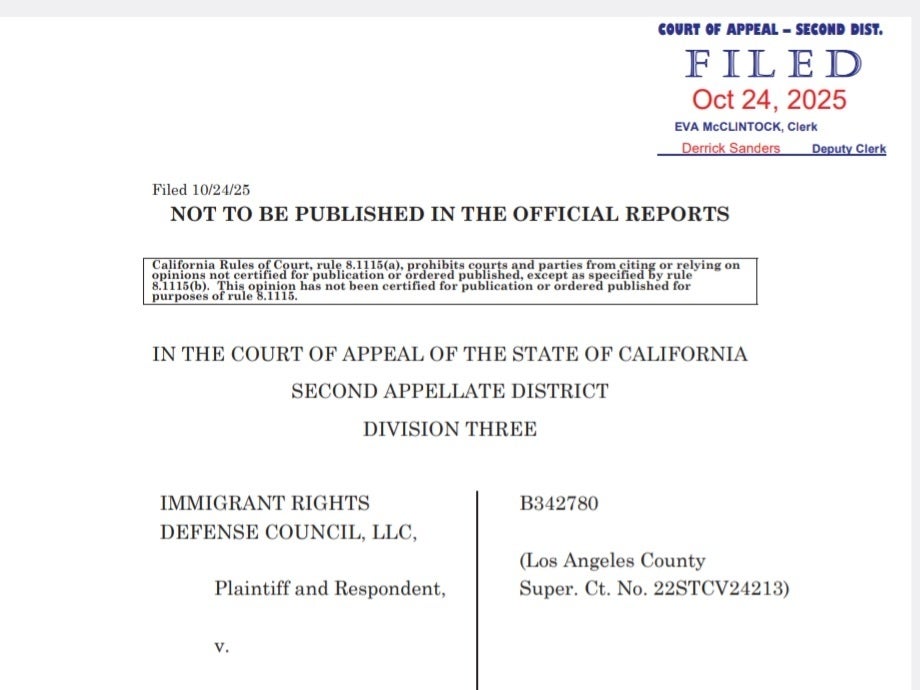
TO READ THE RAMIREZ CASE CLICK BELOW
TO READ A ATTONREY FEE REQUEST CLICK BELOW
Frequently Asked Questions About the Ramirez Appellate Decision
Q1: What was the main issue in Immigrant Rights Defense Council, LLC v. Ramirez?
A: The key issue was whether the plaintiff, IRDC, was entitled to over $83,000 in attorney fees after filing a boilerplate Immigration Consultant Act (ICA) lawsuit. The appellate court found the award excessive and unsupported, reversing it for reconsideration.
Q2: Why is this case important for immigration consultants?
A: It sets a precedent that courts must closely scrutinize inflated attorney fee claims in ICA cases. It empowers consultants to fight back against lawsuits seeking unreasonable settlements or fees.
Q3: What did the appellate court say about the $750 hourly rate and 1.5x multiplier?
A: The court found both unjustified. The increase from $500 to $750/hour was unexplained, and the multiplier made no sense for a routine, boilerplate case with no novel legal issues.
Q4: Can immigration consultants appeal a fee award even if they agree to an injunction?
A: Yes. The appellate court clarified that a stipulated injunction does not waive your right to challenge excessive attorney fees later.
Q5: What is the “alter ego” argument mentioned in the case?
A: Ramirez argued that IRDC was simply a shell for the Attorney's firm. If proven, it means the plaintiff was self-represented — and self-represented attorneys cannot collect fees for their own work.
Q6: What happens if the trial court finds IRDC is the attonrey's alter ego?
A: The plaintiff could be barred from recovering any attorney fees at all. The $83,000 award might be reduced to zero, marking a huge shift in similar cases statewide.
Q7: Does this case affect future ICA lawsuits?
A: Absolutely. It warns plaintiffs that cookie-cutter lawsuits and inflated fee requests will face greater scrutiny and may backfire.
Q8: How can immigration consultants use this case in their defense?
A: By citing IRDC v. Ramirez to challenge inflated billing, oppose multipliers, and expose mass-produced litigation tactics. It shows courts are willing to rein in abuse of the ICA.
Q9: What should you do if you get sued under the Immigration Consultant Act?
A: Contact an experienced defense attorney immediately. Don't ignore the lawsuit or agree to a quick settlement. You may have strong defenses under this new appellate precedent.
Q10: Who can help defend you?
A: The Law Office of Steve Lopez has extensive experience defending immigration consultants against unfair ICA lawsuits. We know how to challenge inflated fee claims, expose boilerplate filings, and protect your busines
Conclusion
If you're an immigration consultant being pressured to settle a lawsuit for a high dollar amount — especially when the violations are minor or technical — you're not alone. And now, thanks to this appellate victory, you have powerful legal precedent on your side.
Don't let scare tactics, inflated billing, or boilerplate lawsuits force you into a bad settlement.
📞 Contact the Law Office of Steve Lopez today for a confidential consultation. We'll help you fight back, protect your business, and minimize your legal exposure
Note:This article discusses public court records and legal arguments made in a California appellate proceeding. It is commentary, not an accusation of wrongdoing by any attorney, law firm, or party. The Ramirez opinion is unpublished and should not be treated as binding precedent except as permitted by California Rules of Court, rule 8.1115.
Comments
There are no comments for this post. Be the first and Add your Comment below.
Leave a Comment