
In 2026, California business owners are facing an increasingly aggressive enforcement environment. The distinction between a W-2 employee and a 1099 independent contractor has never been more serious. Misclassifying a worker isn't just an accounting or billing issue, it's a legal issue that can expose your business to crippling fines, unpaid back taxes, and costly litigation.
Whether you run a small retail shop, a growing startup, or a large service-based company in Los Angeles, understanding these two types of workers and the risks of misclassifying them essential for your business's survival.

W-2 vs. 1099: The Core Difference
At its most basic level, the difference is about how much control the employer has over their work and how they compensation or pay is calculated.
A W-2 employee works under the direct control of the employer. The employer or “Boss” tells them how, when, and where the work is done. The employer withholds payroll taxes, provides workers' compensation insurance, and offers benefits like unemployment and disability insurance.
A 1099 independent contractor, on the other hand, operates as a separate business. They control their own methods and schedule, use their own tools, and are responsible for their own tax withholdings and insurance. You pay them for a specific outcome, not for their time. You don't get to choose which category a worker falls into. The law decides based on the actual working relationship, not what you write in a contract.

California's Strict Standard: The “ABC” Test (AB5)
While the IRS uses a flexible multi-factor analysis, California has adopted one of the strictest worker classification laws in the nation. Under Assembly Bill 5 (AB5), the state uses a rigid three-part “ABC Test”.
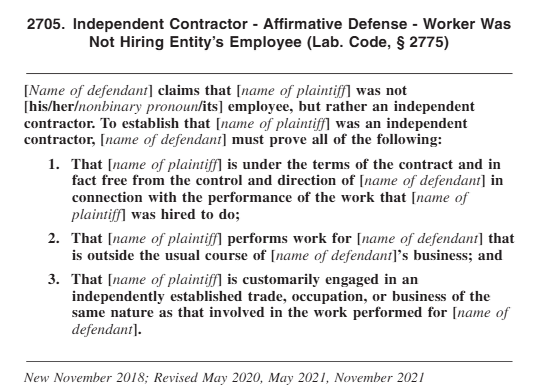
Under the ABC Test, a worker is presumed to be an employee unless the employer can prove the following:
- Autonomy (or Control): The worker is free from the control and direction of the hiring entity in connection with the performance of the work, both under the contract and in fact. This means the business cannot dictate how the work is performed.
- Business: The worker performs work that is outside the usual course of the hiring entity's business. This is the prong that most employers fail. If you are a roofing company that hires roofers, you fail Prong B. If you are a marketing firm that hires an IT consultant, you might pass.
- Commerce (or Trade): The worker is customarily engaged in an independently established trade, occupation, or business of the same nature as the work performed for the hiring entity. The worker must have their own business presence, their own clients, website, and tools, independent of your company.
Failing any single prong means the worker is automatically an employee, regardless of what your contract says. This strict, all-or-nothing standard is the primary reason why many traditional independent contractor relationships in California are now legally considered employment relationships.
Below is the court form outlining the ABC Test.
The Real-World Dangers of Misclassification
If the EDD, the Labor Commissioner, or a private plaintiff reclassifies your 1099 workers as W-2 employees, the financial consequences are devastating and often retroactive for up to four years.
The costs stack in three main layers:
- Back Payroll Taxes and Contributions: You will be liable for the full amount of unpaid Unemployment Insurance (UI), Disability Insurance (DI), Employment Training Tax (ETT), and Personal Income Tax (PIT) withholdings for every misclassified worker plus additional penalties and interest.
- Back Wages and Penalties: Once reclassified, workers are owed everything an employee is entitled to retroactively. This includes:
- Unpaid overtime premiums under Labor Code § 510.
- Meal and rest break premiums under § 226.7 (one hour of pay per missed break).
- Waiting time penalties under § 203 for late final wages (up to 30 days of wages).
- Wage statement penalties under § 226 ($250 per pay period per worker).
- Expense reimbursement under § 2802.
- Statutory Civil Penalties: Under Labor Code § 226.8, employers who willfully misclassify a worker face additional civil penalties:
- $5,000 to $15,000 per misclassified worker for a standard violation.
- $10,000 to $25,000 per misclassified worker if there is a “pattern or practice” of willful misclassification.
Recent Enforcement Actions: A Warning for Employers
The government and private plaintiffs are actively and aggressively pursuing misclassification claims. Recent high-profile cases illustrate the immense risk:
- Grubhub: In January 2026, a U.S. District Court approved a $24.75 million class action settlement resolving nearly a decade of litigation over Grubhub’s alleged misclassification of California delivery drivers as independent contractors.
- The Ritz-Carlton: In July 2025, the California Labor Commissioner’s Office cited the Ritz-Carlton and its subcontractors more than $2 million for misclassifying workers as independent contractors.
- Costco, Ryder, and Mega Nice Trucking: In October 2025, these companies were cited for a combined $868,128 in misclassification violations.

How to Protect Your Business
Given the severe penalties, proactive compliance is essential. Here are immediate steps every business owner should take:
- Audit Your Workforce: Identify every worker currently classified as a 1099 independent contractor.
- Apply the ABC Test: Objectively evaluate each relationship against all three prongs of the California ABC Test. Do not rely on your contract language alone.
- Review Contracts and Practices: Ensure your independent contractor agreements properly reflect an independent relationship and avoid any language that implies control (e.g., dictating hours, requiring specific tools, or managing daily tasks).
- Document Independence: Gather evidence that each contractor truly operates their own independent business, such as business licenses, websites, other client invoices, and proof they provide their own tools.
- Consult a Legal Professional: Worker classification is a high-stakes area of law with constantly evolving standards. An experienced employment defense attorney can help you audit your workforce, restructure relationships, and defend you in the event of an audit or lawsuit
The Law Office of Steve Lopez: Your Partner in Compliance and Defense
Worker misclassification claims are one of the most common and dangerous threats facing Los Angeles businesses today. The penalties are staggering, the enforcement is aggressive, and a single mistake can jeopardize your company's future.
At the Law Office of Steve Lopez, we understand the complexities of both federal and California classification laws. We provide comprehensive employment defense for business owners, helping you navigate audits, defend against claims, and establish compliant worker relationships from the start.
Don't wait for a disgruntled worker to file a claim or for the EDD to come knocking. Contact us today for a consultation to review your worker classifications and ensure your business is protected.
Call the Law Office of Steve Lopez to discuss your case.
Comments
There are no comments for this post. Be the first and Add your Comment below.
Leave a Comment